
What if the most intimidating aspect of a £3,000-a-day Lamborghini Revuelto isn’t its 1,000-plus horsepower, but the simple act of pulling away from the kerb? It’s perfectly natural to feel a flicker of apprehension when you’re handed the keys to a masterpiece of engineering. You likely want to experience the visceral thrill of the engine without the haunting fear of a costly mishap or the embarrassment of a jerky start. Learning how to drive an automatic supercar is an exercise in finesse and electronic management, rather than just simple gear selection. It’s about understanding a machine that’s designed to perform at the limits of physics.
This level of dedicated support is a standard shared by the world’s leading luxury agencies; for those travelling to the Middle East, First Super Car Rental LLC provides a similarly expert introduction to their fleet of supercars in Dubai.
We understand that the transition from a standard luxury saloon to a high-performance beast can feel daunting. You’re right to respect the power; these vehicles demand a different level of intentionality. Our masterclass will teach you exactly how to handle these world-class transmissions and driving dynamics with quiet confidence. We’ll demystify the nuances of dual-clutch gearboxes, explain when to engage those carbon-fibre paddle shifters, and show you how to manage a throttle that’s tuned for the track. By the end of this guide, you’ll be ready to enjoy every mile with the refined assurance of a true connoisseur.
Key Takeaways
- Learn the mechanics of Dual-Clutch Transmissions (DCT) to understand why world-class marques favour these systems for lightning-fast, seamless gear transitions.
- Master the foundational techniques of how to drive an automatic supercar, including the specific ignition sequences and the placement of essential cockpit controls.
- Decipher complex performance modes to elegantly transition the vehicle’s suspension, exhaust note, and shift patterns between spirited driving and effortless touring.
- Acquire practical skills for urban navigation, such as utilising the nose-lift system to protect the vehicle’s undercarriage and managing its distinctive width on the road.
- Benefit from a tailored introduction to performance motoring with the Lamborghini Evo Huracan Spyder, delivered to your chosen location via our nationwide service.
Understanding the Modern Supercar Transmission
To truly grasp how to drive an automatic supercar, one must first appreciate the staggering complexity of the machinery beneath the carbon-fibre chassis. Unlike the traditional gearboxes found in daily drivers, modern marques like Ferrari and Lamborghini employ sophisticated technology that feels more like a precision racing instrument than a convenience feature. These systems are a refined evolution of the automated manual transmission, designed to handle immense torque whilst delivering a seamless connection between the engine and the road.
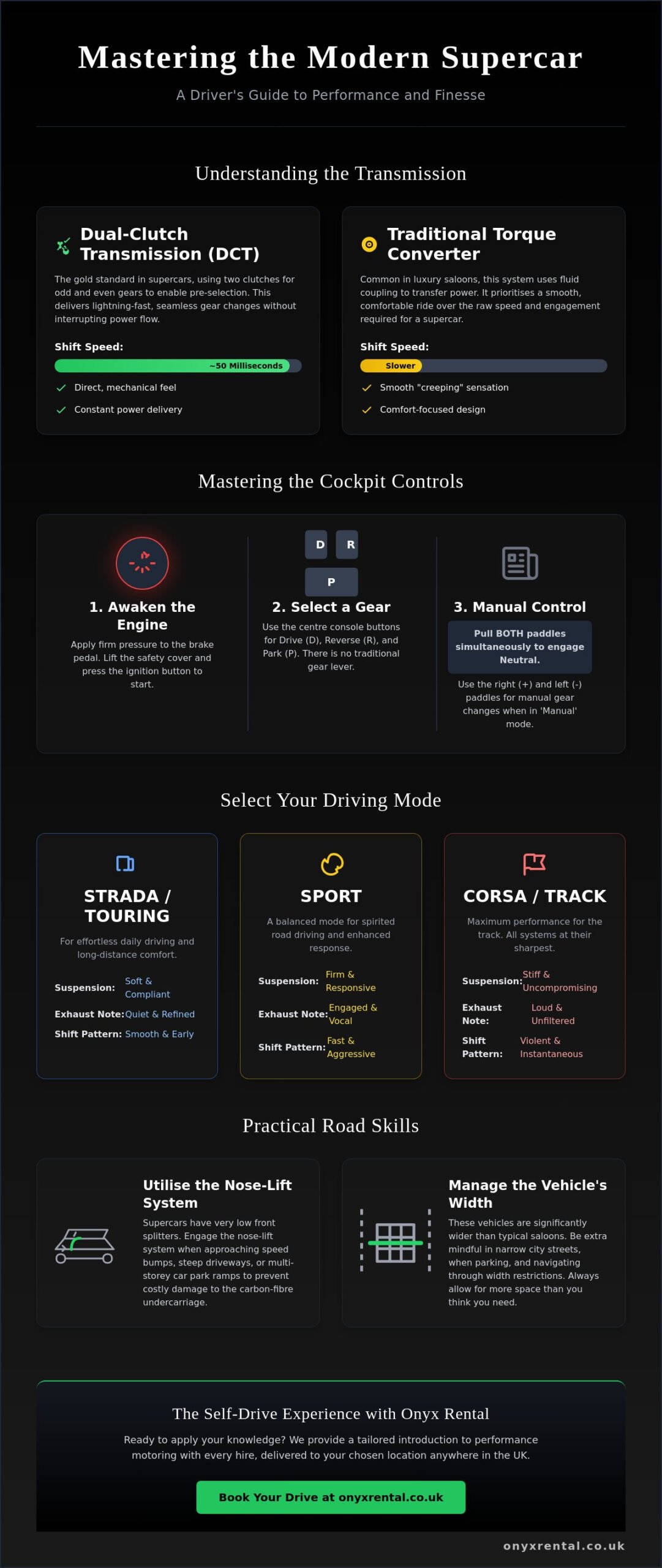
The Dual-Clutch Transmission (DCT) is the undisputed gold standard for high-performance motoring. By using two separate clutches for odd and even gear sets, the vehicle can pre-select the next gear before the current one is even disengaged. This engineering feat allows for gear changes that occur in as little as 50 milliseconds. It’s a speed that’s physically impossible for a human with a manual lever, ensuring that power delivery remains constant and the car’s balance is never upset by a clumsy shift.
To better understand this concept, watch this helpful video:
When you’re learning how to drive an automatic supercar, you’ll notice two distinct personalities. In “Automatic” mode, the car’s logic focuses on smoothness and efficiency, often shifting early to maintain a composed demeanour. Switch to “Manual” mode, and the paddles on the steering column grant you total authority. This allows you to hold a gear right up to the redline, transforming the vehicle from a refined cruiser into a focused performance machine with a simple flick of the wrist.
The Mechanics of Speed: DCT vs. Torque Converters
Standard luxury saloons typically use torque converters to provide a smooth, “creeping” sensation when you lift off the brake. Many supercars intentionally lack this function. When you release the brake pedal, the car may stay stationary until you apply positive throttle. This creates a more mechanical, direct connection. It offers a visceral feel that reminds you you’re commanding a race-bred engine rather than a soft executive commuter.
The Role of the Electronic Control Unit (ECU)
The ECU acts as a digital guardian, managing rev-matching with surgical precision. It blips the throttle during downshifts to ensure the engine speed matches the wheel speed perfectly. This intelligence prevents “money shifts”, where a driver might accidentally select a gear that would over-rev the engine. If you attempt a downshift whilst the RPMs are too high, the computer will simply refuse the command, protecting the car’s high-value heart from damage.
Mastering the Cockpit: Controls and Paddle Shifters
Entering a high-performance cockpit is an exercise in sensory immersion. The scent of hand-stitched leather meets the cool touch of machined aluminium, creating an atmosphere of focused luxury. Unlike a standard executive car, the layout is strictly driver-centric, with every toggle and screen positioned to minimise distraction. Mastering how to drive an automatic supercar begins with understanding this unique environment, where form and function are balanced with surgical precision.
To awaken the engine, firm pressure on the brake pedal is mandatory. In a Lamborghini Revuelto or Huracan, you will likely find the ignition tucked beneath a red safety cover, a design choice reminiscent of a fighter jet. Press and hold this button until the engine settles into its distinctive idle rhythm. You will not find a traditional gear lever here; instead, the central console features specific buttons or selectors for Drive, Manual, and Reverse. The Park function is often a separate, smaller button that ensures the transmission is locked before you switch off the ignition.
One of the most distinctive features of these transmissions is the method used to engage Neutral. In many performance models, pulling both steering-mounted paddles toward you simultaneously will disengage the gears. This is a vital skill for brief stops or when carefully manoeuvring into a parking space. The paddles themselves are often crafted from cold aluminium or lightweight carbon fibre, providing a satisfying mechanical click that confirms your command has been received by the car’s computer. Learning how to drive an automatic supercar involves developing a feel for this tactile feedback.
As noted in this beginner’s guide to supercar driving, your seating position is crucial for maintaining control. Once you are settled, you will find the paddles are your primary point of contact with the car’s performance. They are designed to be intuitive, yet they require a level of respect and intentionality that standard automatics simply do not demand.
Using Paddle Shifters Correctly
The industry standard is elegantly simple: the right paddle handles upshifts, whilst the left manages downshifts. Whilst the automatic brain is exceptionally capable, taking manual control allows for superior engine braking when approaching a corner. It is essential to keep your hands at the 9 and 3 positions on the steering wheel. This ensures the paddles are always within reach of your fingertips, even during spirited cornering or complex manoeuvres.
Engaging Reverse and Parking Modes
Reversing a supercar requires patience and a gentle touch. You must ensure the vehicle has come to a complete standstill before engaging the “R” button or lever. Due to the high-performance nature of the gearbox, rushing this process can cause unnecessary stress on the mechanical components. Before exiting the vehicle, always verify that the electronic handbrake is active. Many modern systems engage this automatically when you select Park, but a manual check provides the peace of mind expected in the luxury sector. If you wish to experience this tactile precision firsthand, you might consider exploring the fleet at Onyx Rental.
Driving Dynamics and Performance Modes
Beyond the physical controls discussed previously, the true character of a modern masterpiece is governed by a small, unassuming dial. On a Lamborghini, this is the Anima; on a Ferrari, it is the Manettino. These selectors act as the conductor of a high-performance orchestra, recalibrating the car’s soul to suit your environment. Mastering how to drive an automatic supercar necessitates a deep understanding of these modes, as they fundamentally alter the vehicle’s behaviour, from the firmness of the suspension to the ferocity of the gear shifts.
One must also master the art of the progressive right foot. These engines are tuned for instant response. An aggressive jab at the throttle can result in an unsettling surge of power that overwhelms the tyres. Instead, apply pressure with a smooth, rolling motion. This ensures the delivery of torque remains manageable and elegant, allowing the car’s computer to find the perfect balance between acceleration and grip. It is this finesse that separates a seasoned driver from a novice.
Strada vs. Sport: Finding the Sweet Spot
Strada, or “Street” mode, is your primary ally for the British road network. It keeps the exhaust note polite and the suspension compliant, making it the ideal choice for city centres or long motorway stretches. Switching to Sport mode transforms the experience. The exhaust valves open to release a signature roar, the steering gains a reassuring weight, and the gearbox sharpens its reflexes. It is a mode designed for the open road, providing heightened sensory feedback without sacrificing the safety net of electronic stability systems. This balance is essential when learning how to drive an automatic supercar with confidence.
The Dangers of Track Modes on Public Roads
Corsa or Race modes are often misunderstood by enthusiasts. Whilst they offer the most visceral experience, they are strictly intended for the circuit. These settings frequently disable or significantly reduce traction control. In the unpredictable, often damp climate of the UK, engaging Corsa on a public highway is a risk that outweighs the reward. The gear shifts become intentionally violent to maximise speed, which can easily break traction on a greasy surface. We always recommend keeping safety systems active during a self-drive hire to ensure your journey remains as secure as it is unforgettable. Precision and safety should always be your highest priorities.
Practical Road Skills and Supercar Etiquette
Commanding a high-performance vehicle on the public highway requires more than just an understanding of the gearbox. It demands a recalibration of your spatial awareness. Whilst a standard executive saloon might feel nimble, a supercar often possesses a significantly wider track. This footprint is essential for high-speed stability, but it creates a unique challenge when navigating narrow country lanes or tight urban thoroughfares. Learning how to drive an automatic supercar effectively involves acknowledging that the car occupies more of the lane than you might initially expect. You must be mindful of the kerb at all times. The alloy wheels on these machines are as delicate as they are beautiful.
Visibility is the next adjustment for the discerning driver. The low-slung seating position, designed to lower the centre of gravity, naturally restricts your field of vision. Rear windows are often little more than decorative slits, particularly in mid-engined masterpieces. You must rely heavily on your wing mirrors and high-definition reverse cameras to compensate for the significant blind spots inherent in such aerodynamic designs. Additionally, when parking or handing the keys to a valet, always verify that the vehicle’s in a “Park” state. Ensure the electronic handbrake’s firmly engaged and the vehicle’s fully secured before you step away.
Navigating Speed Bumps and Inclines
The front splitter of a vehicle like the Lamborghini Evo Huracan Spyder is a piece of precision carbon-fibre engineering. It sits remarkably close to the tarmac. To protect this, you must master the nose-lift system. This feature hydraulically raises the front axle by several centimetres, providing the necessary clearance for speed humps or steep driveways. Always approach these obstacles at an angle rather than head-on. This diagonal approach further reduces the risk of scraping the undercarriage. Never rush this process. Patience is the hallmark of a true supercar enthusiast.
Blind Spots and Lane Discipline
Because you’re seated so low, other road users may occasionally lose sight of you in their own blind spots. Professional lane discipline’s therefore vital. Use your indicators early and clearly to signal your intentions well before you begin a manoeuvre. You must also manage the “paparazzi effect”. A world-class vehicle attracts attention. You’ll inevitably find other motorists or pedestrians attempting to take photographs. Maintain your focus on the road ahead. Ignoring the distractions ensures your journey remains safe and composed. If you’re ready to put these skills into practice, you can book your supercar experience with Onyx Rental today.
The Self-Drive Experience with Onyx Rental
Mastering the technical nuances of high-performance machinery is only half the journey. The true transformation occurs when you step out of the theoretical and into the driver’s seat of a meticulously prepared vehicle. For many, the Lamborghini Evo Huracan Spyder represents the perfect introduction to the world of exotic performance. Its dual-clutch transmission is remarkably intuitive, offering a refined balance between daily usability and the visceral excitement of a naturally aspirated V10. It allows you to focus on the road whilst the car manages the complexities of gear selection with flawless precision.
We believe that a premium experience should be entirely effortless. This is why our Nationwide Vehicle Delivery Service ensures your chosen asset arrives at your doorstep, regardless of your location in the UK. Upon arrival, a member of our specialist team conducts a comprehensive handover. We don’t simply hand over the keys; we walk you through every dial, mode, and paddle shift function until you feel entirely at ease. If you have questions about how to drive an automatic supercar during your journey, our 24/7 customer support remains at your disposal for total peace of mind.
Choosing Your Ideal Performance Machine
Your selection should reflect your personal style and the nature of your journey. The Audi R8 V10 Spyder is often praised for its user-friendly technology and composed demeanour, making it an excellent choice for those new to the segment. In contrast, a Ferrari 296Gts Spyder offers a more dramatic, high-revving experience that rewards a focused driver. For clients requiring additional space without compromising on prestige, our luxury SUV hire UK options, such as the Lamborghini Urus or Rolls Royce Cullinan, provide a commanding presence on the road. These vehicles are ideal for high-profile weddings, proms, or corporate events where first impressions are paramount.
The Onyx Standard of Excellence
With 20 years of experience in the luxury automotive sector, we’ve refined our service into an art form. Every vehicle in our fleet undergoes meticulous maintenance and rigorous safety checks to ensure peak performance. We operate with a quiet confidence that only comes from decades of market leadership and an uncompromising commitment to our clients’ status. Your journey isn’t just a rental; it’s an immersive entry into a lifestyle defined by excellence and sensory satisfaction. Book your automatic supercar experience today and discover the difference that two decades of expertise makes.
Embrace the Pinnacle of Automotive Excellence
Mastering how to drive an automatic supercar is an evolution of your driving identity, moving beyond the mundane into a realm of heightened sensory awareness. You’ve explored the technical brilliance of dual-clutch systems, the nuances of performance modes, and the vital importance of refined road etiquette. Now, the only remaining step is to settle into the hand-stitched leather cockpit and feel the engine’s pulse for yourself. The transition from theory to the open road is where the true magic of high-performance engineering comes alive.
With over 20 years of luxury car hire experience, Onyx Rental is your trusted partner in this high-performance journey. Our pristine fleet, featuring the finest examples from Lamborghini, Ferrari, and Rolls-Royce, is meticulously maintained and ready for nationwide doorstep delivery to suit your bespoke schedule. Every handover is conducted with the refined discretion and professionalism you expect from a market leader that understands the nuances of prestige. We ensure you feel entirely composed before you ever engage the first gear.
Experience the thrill of a supercar with Onyx Rental and discover the quiet confidence that comes from commanding true excellence. Your journey towards masterclass control begins today.
Frequently Asked Questions
Do I need a special licence to drive an automatic supercar in the UK?
No, a standard full UK driving licence is entirely sufficient for commanding these vehicles on public roads. Whilst the performance levels are extraordinary, the legal requirements remain the same as any other passenger car. You must, however, ensure you meet the specific age and insurance criteria set by your provider, as most luxury rentals require the driver to be at least 25 years of age.
Is it easier to drive an automatic supercar than a manual one?
Modern dual-clutch transmissions make these vehicles significantly more accessible than their manual predecessors. You don’t have to worry about complex clutch control or the risk of stalling in traffic. Learning how to drive an automatic supercar allows you to focus your attention on the road and the car’s incredible dynamics, rather than the mechanical labour of shifting gears.
What happens if I accidentally pull both paddle shifters whilst driving?
Pulling both paddles simultaneously will typically engage Neutral, which disconnects the engine from the driven wheels. If this occurs whilst you are in motion, the car will simply coast without causing any mechanical damage. You can easily rectify this by pulling the right-hand paddle to re-engage the appropriate gear, allowing the car’s computer to select the most suitable ratio for your current speed.
Can I drive a supercar in automatic mode all the time?
You can certainly leave the vehicle in fully automatic mode for the duration of your journey. In this setting, the car’s sophisticated software manages every shift with surgical precision and efficiency. It’s the preferred choice for navigating city centres or enjoying a relaxed motorway cruise, where the car behaves with the same civility as a high-end luxury saloon.
Are automatic supercars faster than manual versions?
Modern automatic gearboxes are undeniably faster than any manual transmission operated by a human hand. A dual-clutch system can execute a gear change in a fraction of a second, ensuring there is virtually no interruption in power delivery. This superior speed and efficiency are why almost all contemporary performance marques, including Ferrari and Lamborghini, have moved away from traditional manual levers.
How do I engage reverse in a Lamborghini or Ferrari?
Reverse is engaged via a dedicated button or lever on the centre console, usually marked with a prominent ‘R’. In many models, you must have your foot firmly on the brake pedal and the car must be at a complete standstill before the gear will lock in. This safety protocol prevents accidental engagement whilst moving forward, protecting the high-value transmission from unnecessary stress.
What should I do if the car feels too powerful or sensitive?
Ensure the vehicle is set to its most relaxed driving mode, such as Strada or Comfort, to dampen the throttle sensitivity. These modes are specifically designed to make the car’s immense power feel more progressive and manageable for everyday road conditions. Always use a gentle, rolling motion with your right foot rather than sudden stabs at the pedals to maintain smooth and elegant progress.
Do supercars have a “creep” mode like standard automatic cars?
Many performance-oriented dual-clutch systems do not feature a traditional creep function and will stay stationary when you lift off the brake. This behaviour mimics a manual gearbox and requires a small, positive input from the throttle to begin moving. Understanding this nuance is an essential part of how to drive an automatic supercar, particularly when you are performing delicate manoeuvres in confined spaces.